
AWS’s newest Bedrock AgentCore example gives an AI agent a consequential job—find replacement flights and draft compensation language after a cancellation—but not the authority to book a seat or issue a payment. Those actions stay in deterministic AWS Step Functions tasks, after validation code checks the agent’s proposal against live inventory and business rules.
That is more than a cautious airline demo. It is a useful correction to the common picture of “multi-agent” systems, where a supervisor model chooses which specialist runs, which tool is called, and when an answer becomes action. AWS’s September 14 reference pattern shifts those decisions into a workflow engine: agents propose; code validates; an explicit route either executes or sends the case to a person.
The agent is not the control plane
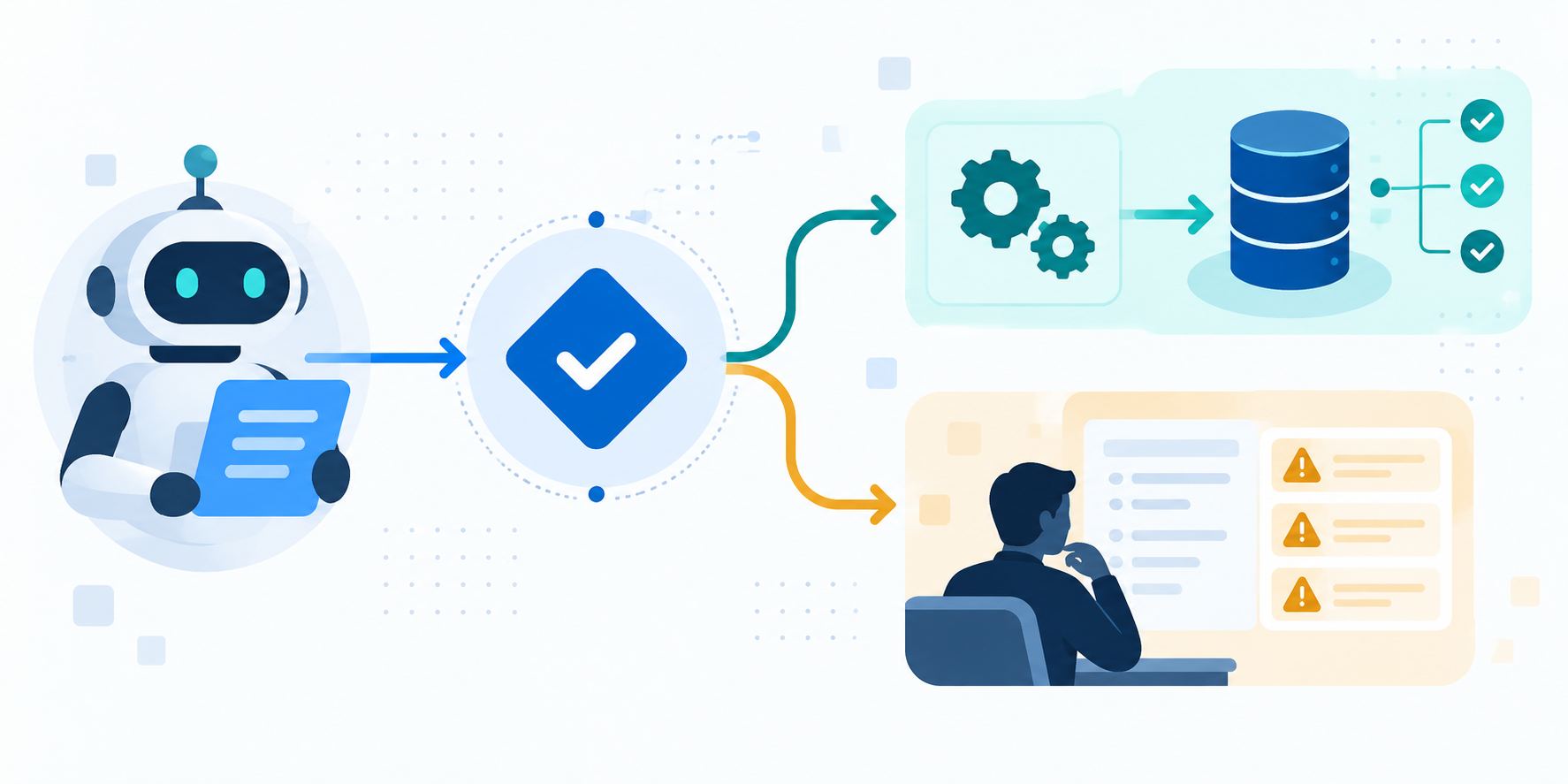
In AWS’s example, a flight-cancellation event starts a state machine. A deterministic enrichment step fetches booking and preference data. A Distributed Map fans work out across affected passengers. AgentCore agents then propose rebooking options and draft customer-facing copy. Lambda validation tasks check whether flights exist, have seats, meet fare and route rules, and satisfy the organization’s entitlement logic. Only then can a deterministic task call the booking or payment system.
The distinction is essential. Language models are useful when a situation is messy: comparing alternatives, explaining trade-offs, or turning a collection of constraints into a readable recommendation. They are a poor final source of truth for a live seat count, a compensation rule, or an action that must be safely retried. A confident sentence is not a valid reservation.
| Stage | Primary owner | Why it belongs there |
|---|---|---|
| Propose options and draft language | AgentCore agent | The task benefits from flexible reasoning over incomplete or varied inputs. |
| Check inventory, fares, and entitlement | Deterministic validation code | Rules and live source systems can be tested, versioned, and audited. |
| Choose automated execution or review | Step Functions Choice state | A defined policy is more reproducible than a model classification. |
| Book, pay, or notify | Deterministic service task | Execution can use idempotency tokens and bounded permissions. |
Source: AWS’s September 14, 2026 reference architecture. The responsibility mapping is a concise restatement; the implications are AI News Fab analysis.
The operational advantage is traceability
AWS argues that Step Functions can record every state transition, input, and output, creating a per-decision record when paired with durable persistence. It also keeps the agent invocation bounded: the optimized AgentCore harness integration is request-response only, with an extended task timeout of up to 15 minutes. A separate callback task, rather than the agent call, holds a case for human approval.
That separation makes incident review less ambiguous. An operations team can ask: What did the agent suggest? What data did the validator read? Which rule failed? Who approved an exception? Did a retry attempt the action again? Those questions are much harder to answer if the workflow is buried inside a supervisor prompt and an unstructured trace.
The same design also protects downstream systems. AWS’s sample sets Map concurrency to 1,000 even though Distributed Map can run up to 10,000 child executions by default. A model may be able to reason at high volume; an airline inventory system, claims service, or CRM may not be able to absorb the resulting writes. Concurrency limits are therefore part of agent safety, not an implementation detail.
The hidden cost is not removed—it moves
This pattern does not make automation cheap or simple. Someone still has to own the validators: maintain eligibility tables, test booking rules, reconcile source-of-truth data, define when a case is safe to auto-confirm, and design the human queue for everything else. The more important the decision, the less credible “the agent handled it” becomes as an operating model.
There is also an observability limit. AWS notes that the optimized harness integration returns only the final assistant message to the state machine. That is enough to sequence the workflow, but it is not a complete account of a model’s internal path or tool-by-tool reasoning. Teams still need to decide what prompts, tool results, model metadata, and validation outcomes to log—and how long they can retain them under their privacy and compliance obligations.
A practical test for other agent projects
The airline example generalizes to refunds, insurance claims, access changes, procurement approvals, healthcare administration, and many internal IT actions. The domain changes; the split should remain. Let the agent rank options, extract evidence, draft an explanation, and flag ambiguity. Let a tested service decide whether the proposal is valid and whether an irreversible action is permitted.
Before shipping, a team should identify each point where an agent output crosses into a system of record. For every crossing, name the validator, the source of truth, the retry behavior, the idempotency key, the maximum concurrency, the human escalation path, and the audit record. If any of those answers is “the model will decide,” the workflow has probably given the model more authority than its evidence warrants.
What to watch
AWS’s reference architecture is not evidence that AgentCore will suit every workload, nor that deterministic validation catches every bad outcome. Validation code can be stale, incomplete, or pointed at the wrong data. The architecture does, though, make those failure modes visible and testable—a better starting point than treating an agent prompt as a business process.
The competitive question is now less about which vendor has the most impressive agent demo. It is whether a platform gives teams a credible way to constrain execution, attribute cost, inspect exceptions, and roll back failures. For high-consequence workflows, the durable product may be the gate around the model.
Sources
- AWS Compute Blog: Validating multi-agent decisions with Step Functions and Bedrock AgentCore
- AWS Step Functions: Map state documentation
- AWS Step Functions: callback pattern documentation
- AI News Fab: DeepSeek V4.1-Flash Makes AI Cost a Cache Problem
Corrections
No corrections. Recheck AWS service limits, regional availability, and pricing before publication because they can change.