
“Paid” and “zero data retention” do not fully describe the Google Gemini data lifecycle. Before sending sensitive data, developers and security buyers need to evaluate the project, service, API feature, state mechanism and logging configuration involved. That review should distinguish vendor-operated abuse monitoring, developer-controlled logging and feature storage, because each path has a different purpose, duration and control surface for the customer.
This source-based guide reflects Google’s published documentation as of Sept. 19, 2026. It does not report hands-on testing or offer a legal conclusion.
Start with the free-versus-paid distinction
Google’s Gemini API terms distinguish unpaid from paid services. For unpaid Gemini API use in the United States, prompts and responses may be used to improve Google’s products, and human reviewers may read, annotate or otherwise process them.
For the Gemini Developer API, a project is paid when its associated Google Cloud project has active billing. Google says paid prompts and responses are not used to improve products, although they may be logged for a limited period for abuse prevention.
Retention therefore does not necessarily mean training or product-improvement use. A paid request may be excluded from those uses while being retained temporarily for another stated purpose.
Abuse monitoring has a documented 55-day period
Google’s abuse-monitoring documentation specifies 55 days and says authorized employees may review content flagged by automated safety systems. The paid terms use the broader phrase “limited period,” so reviewers should preserve both statements and confirm their applicability to the service, project and agreement.
Abuse monitoring supports policy enforcement and safety. That purpose does not eliminate the need to assess retained sensitive content, but its retention period should not be mischaracterized as evidence that paid prompts are used to train models.
Zero data retention still requires a feature-by-feature review
Google’s zero data retention guide, updated Sept. 14, 2026, describes features with different storage behavior. The label therefore has to be tested against the features a workload actually enables.
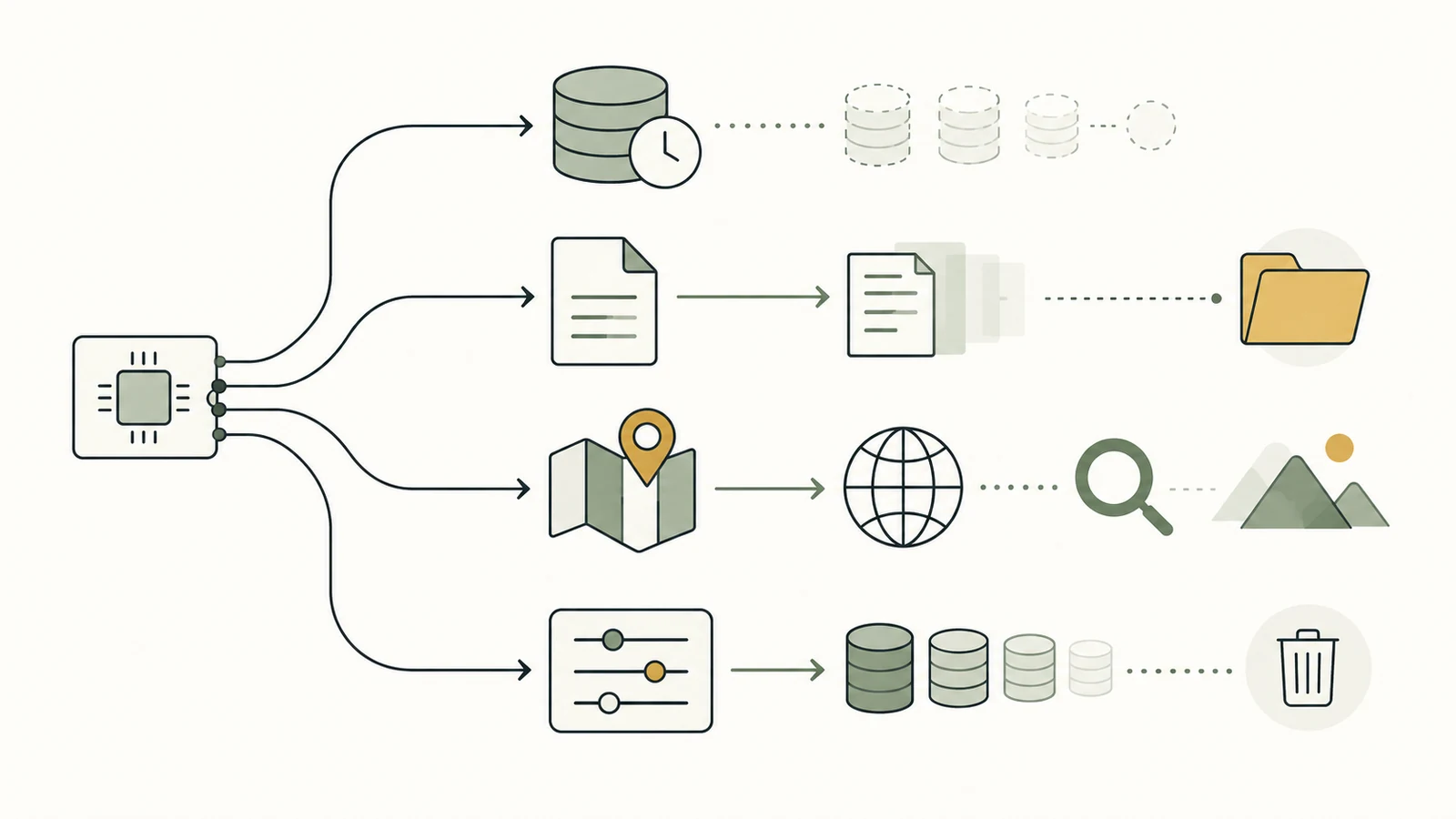
Search and Maps grounding
Search grounding and Maps grounding each retain prompts, context and outputs for 30 days. This retention cannot be disabled while either feature is used, so a stricter workload may need to avoid grounding.
Interactions API conversation state
The Interactions API stores conversation state by default. Set store: false to opt out, and confirm that production requests send the parameter where storage is unwanted.
Live API session resumption
Live API session resume can retain state for up to 24 hours. The feature enables continuity but adds stored conversational context to the data lifecycle.
File API storage
File API items remain stored until deleted or expired. Teams should identify who owns deletion, when each file expires and how abandoned or test uploads are handled.
Explicit and implicit caching
Explicit context caching lasts for its configured TTL. Implicit caching is described as in-memory, project-isolated and subject to a 24-hour TTL. Google says this RAM-only mechanism does not violate ZDR, making the distinction between memory and storage at rest material.
AI Studio developer logs are a separate control
AI Studio’s logging policy describes optional, developer-owned API logs with a default maximum retention of 55 days, configurable to 7, 14, 28 or 55 days. These are distinct from abuse-monitoring logs, so changing one setting should not be assumed to change the other retention path.
Dataset copies created from those logs can persist beyond the selected window with no set retention period. Cleanup should therefore include derived datasets, not only the original logs.
A pre-deployment checklist for sensitive data
1. Confirm the service and project
- Identify whether the integration uses the Gemini Developer API, AI Studio-related tooling, Vertex AI or another Google service.
- Record the project, model, endpoint and optional features; do not transfer one service’s retention statement to another.
2. Verify billing
- Confirm active billing on the Google Cloud project used by each production, staging and test environment if paid treatment is required.
- Do not infer API billing status from other Google purchases or subscriptions.
3. Separate use from retention
- For unpaid U.S. use, account for product-improvement use and human review of prompts and responses.
- For paid use, document the exclusion from product-improvement use and separately assess abuse monitoring and authorized review.
4. Inspect state and grounding
- Verify
store: falsewhere Interactions API state is unwanted and decide whether Live API session resume is appropriate. - Determine whether Search or Maps grounding will receive sensitive material and whether its unavoidable 30-day retention is acceptable.
5. Establish ownership for files and caches
- Define deletion and expiration procedures for File API items and TTLs for explicit caches.
- Record implicit caching’s separate RAM-only, project-isolated, 24-hour behavior.
6. Audit AI Studio logs and datasets
- Check whether optional developer-owned logging is enabled and select 7, 14, 28 or 55 days.
- Inventory dataset copies that may outlive that window, and keep these logs distinct from abuse logs.
7. Match contractual requirements
- Identify any requirement for guaranteed ZDR or enterprise processing terms and compare it with the applicable service documentation and agreement.
- Recheck the analysis when the service, model, feature, billing state or agreement changes.
Where Vertex AI fits—and where caution remains
The Gemini API ZDR guide directs customers needing guaranteed zero data retention or enterprise processing terms to Vertex AI. That recommendation does not establish identical treatment across every Vertex AI feature and configuration.
Google’s Vertex AI zero data retention documentation identifies exceptions and feature-specific considerations. Buyers should evaluate the precise service and configuration rather than treating the platform name as a blanket guarantee.
Questions the documentation alone may not answer
Applicability can depend on the service, billing status, Workspace status, model, enabled feature and governing agreement. Published documentation establishes a baseline, but sensitive deployments may require account-specific confirmation and review of negotiated terms.
Because documentation can change, teams should record the materials and date used for approval, then reassess when Google changes its terms, adds a feature or modifies the integration.
The bottom line
A Gemini retention review is a matrix, not a yes-or-no label. Paid terms address product-improvement use; abuse monitoring and features such as grounding, conversation state, files, caches and developer logs have separate lifecycles.
Before sending sensitive data, verify the exact project’s billing state, identify each storage-producing feature, inspect logging and state controls, and compare the data flow with contractual requirements. “Paid” is a starting point, not the end of the review.
Related: Gemini Lands on Windows, but the Real Product Is Access—Not Local AI.
Images: AI-generated editorial illustrations. They do not depict actual events or product interfaces.