
Microsoft says every U.S. school district will be able to add a new set of AI privacy protections to a new or existing Microsoft agreement beginning Nov. 1, 2026. The terms address student prompts, files, AI outputs, behavioral patterns and other sensitive information—but they will not automatically govern every Microsoft product used in schools.
The central question is therefore not only what the standard promises. It is whether districts request and incorporate it, and which of their AI services qualify for coverage.
What the new school AI standard promises
The 31-page agreement establishes 10 principles for school AI safety and privacy. It was signed by the National Academy for AI Instruction and Microsoft Corporation on Sept. 7, 2026, before the American Federation of Teachers, United Federation of Teachers and Microsoft announced the standard on Sept. 9.
The signed standard defines covered data broadly. Its protections extend to information such as student prompts and outputs, uploaded files, memory, behavioral patterns and metadata.
Among its principal commitments, the standard:
- bars covered data from being used to train or improve AI models, apart from a narrow safety and security exception;
- prohibits selling covered data or using it for advertising or product development;
- requires human oversight for consequential decisions;
- prohibits companion features designed to encourage emotional dependence; and
- requires notice of a covered breach within 72 hours.
These are substantive contractual protections. They address several distinct risks at once: secondary use of school data, automated decision-making without meaningful human involvement, emotionally manipulative design and delayed breach disclosure.
Districts appear to have to opt in
Microsoft’s fact sheet says that, starting Nov. 1, every U.S. school district can add the protections to a new or existing Microsoft agreement without waiting for renewal or renegotiating the broader contract.
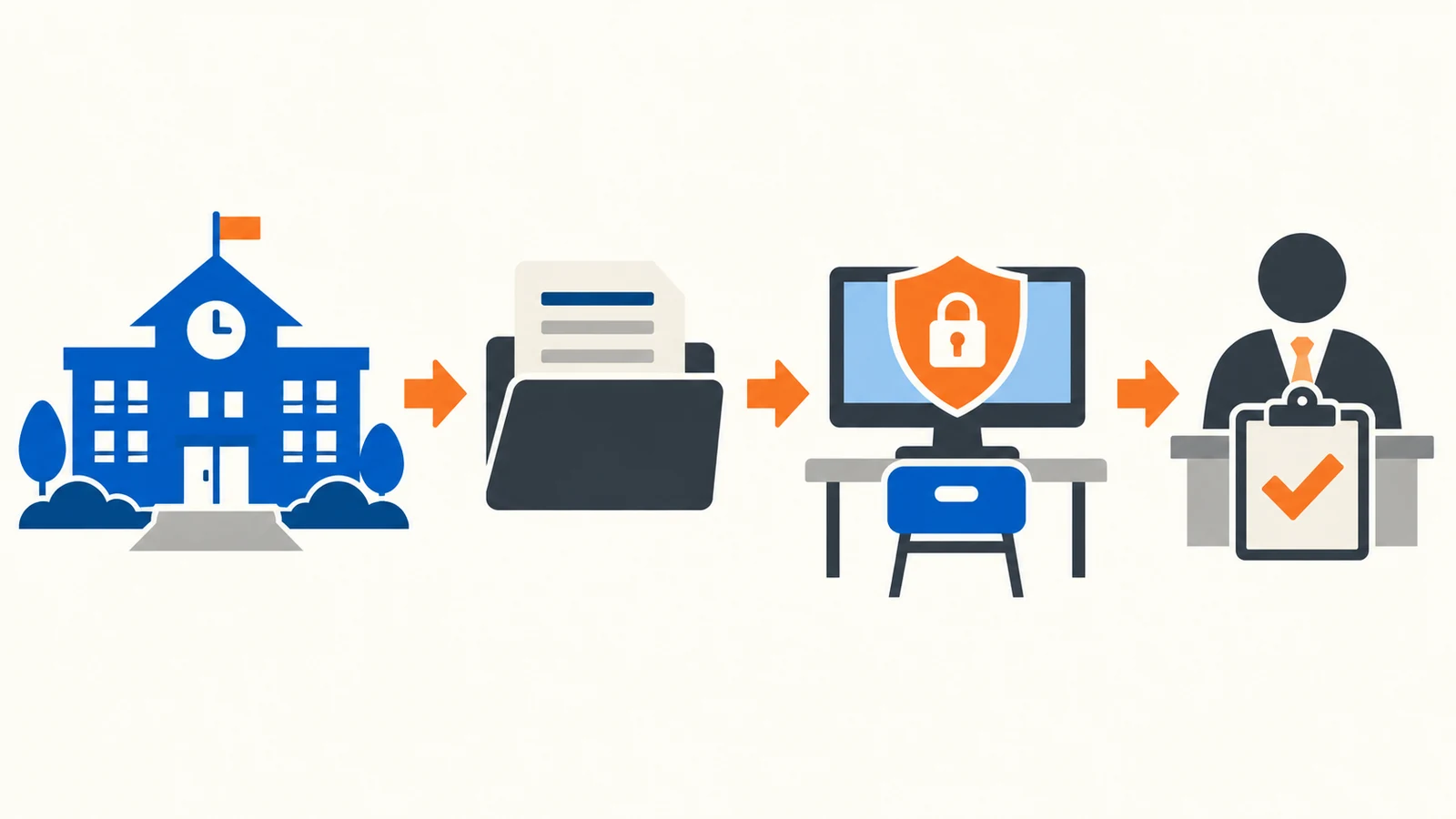
That availability commitment should not be mistaken for automatic coverage. The agreement’s mechanism calls for a district to request or opt into the terms. Once incorporated, the protections become enforceable as part of the district’s agreement.
This distinction matters because abbreviated accounts of the announcement can sound broader than the underlying implementation. The terms may be nationally available, but their practical reach depends on district action.
Families do not receive the contract right directly
The agreement gives contractual rights to participating districts after incorporation. It does not give families an independent right to add or enforce the terms themselves.
Parents and school communities can still ask whether their district has made the request, when it expects the terms to take effect and which services the district believes are covered. Those questions may reveal more about the immediate protection of student data than the national announcement alone.
Which Microsoft products are covered?
The agreement defines covered products as generative AI services primarily designed and marketed for education and provided under an authenticated school agreement.
It excludes general-purpose productivity, search, cloud and workplace tools. The materials do not enumerate every covered Microsoft product or version, leaving districts to determine how the definition maps onto the services they actually deploy.
That boundary is consequential. A district may adopt the standard yet still use Microsoft tools outside its scope. It should therefore identify not only whether it has incorporated the terms, but also which services, accounts and classroom workflows it considers covered.
What the standard does not settle
The agreement is not a universal industry policy. According to Associated Press reporting, Google had not said whether it would offer similar protections, while OpenAI and Anthropic were discussing terms with the AFT.
It also does not resolve whether children should use classroom AI, at what age such use is appropriate or what educational evidence should be required before deployment. A child-safety advocate cited by the AP cautioned that privacy safeguards should not be interpreted as an endorsement of classroom AI use.
Nor is there yet an implementation record to assess. As of the Sept. 19 reporting cutoff, the Nov. 1 availability date was still in the future. Claims about compliance, enforcement or district uptake would therefore be premature.
The funding relationship deserves disclosure, not an automatic conclusion
The National Academy for AI Instruction was created through a five-year, $23 million partnership involving Microsoft, according to the AP and Education Week. That relationship is relevant context when evaluating the agreement’s development and oversight. On its own, however, it is not proof that the protections are ineffective or that a conflict compromised the result.
Education Week also raised questions about how protections operate around practices such as de-identification. That sector context reinforces the need to examine the contract language and actual product behavior rather than relying on the standard’s label alone.
What parents and school communities can ask now
Before or after Nov. 1, families can ask district leaders for specific answers:
- Will the district request and incorporate the Microsoft AI safety and privacy standard?
- When will the added terms become effective?
- Which Microsoft AI services and versions does the district consider covered?
- Which Microsoft productivity, search, cloud or workplace tools remain outside the standard?
- How will the district document human oversight of consequential decisions?
- What process will the district use to receive, evaluate and communicate breach notices?
- How will the district verify that covered data is not used for model improvement, advertising or product development?
The bottom line
The new standard contains meaningful restrictions that could strengthen the contractual treatment of student data. Its practical value, however, will be determined locally: districts must incorporate the terms, and coverage turns on whether a service fits the agreement’s education-focused definition.
For parents, the most useful next step is not to assume that the announcement changed every Microsoft relationship. It is to ask the district whether it will opt in, obtain the incorporated language and identify the exact products to which it applies.
Related: Apple’s Siri AI Arrives With a Bigger Promise—and Clearer Limits.
Images: AI-generated editorial illustrations. They do not depict actual events or product interfaces.