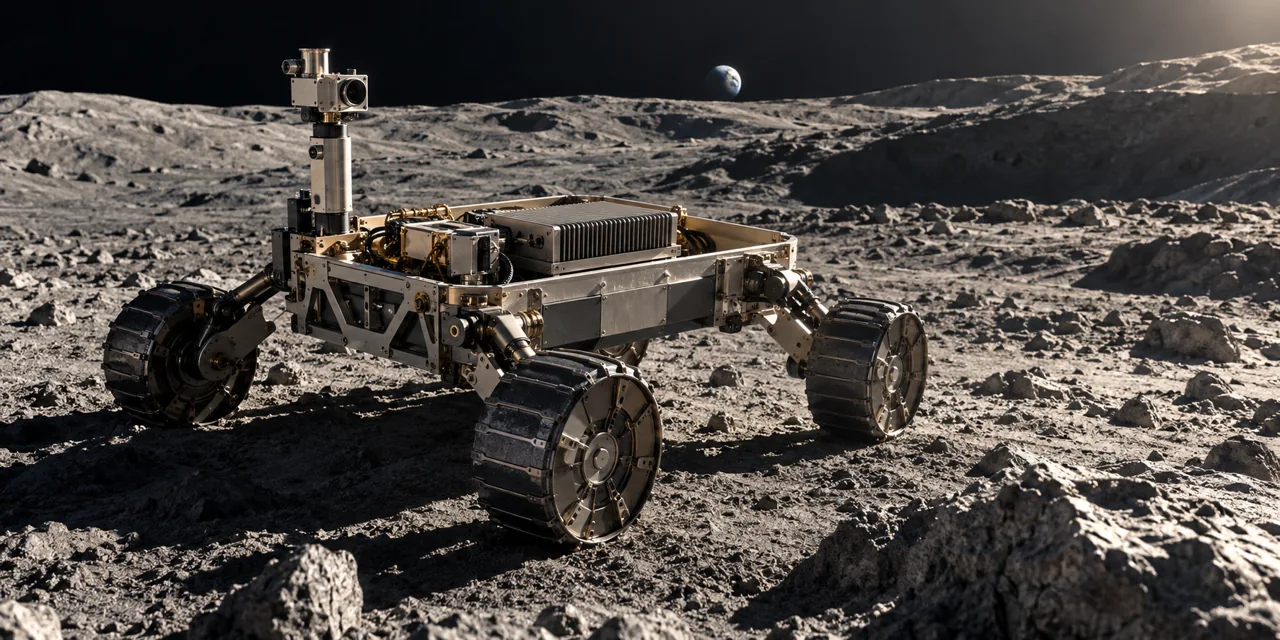
HPE announced Spaceborne Computer-4 on October 20 as a planned payload for Astrolab’s FLIP rover aboard Griffin-1. Its proposed destination is the Moon; its performance there remains an open question. As of October 22, 2026, KST, the reviewed announcements establish a mission plan, not a completed lunar deployment. HPE’s announcement sets out the computing ambitions.
The distinction matters when evaluating the news. A list of intended experiments tells readers what a team hopes to investigate. It cannot yet tell them which tasks will finish successfully, what useful output they will produce, or how consistently the system will operate.
What HPE intends to run
HPE describes a self-contained, fanless module with low-power CPU and GPU hardware. Planned work includes language-model retrieval-augmented generation, vision inference, LiDAR processing, and an AI services container. The company also describes NASA’s planned FLUID experiment coordinating three models trained on Earth, Moon, and ISS data, plus onboard document search. HPL and HPCG benchmarks are scheduled, with results still ahead. These are company-reported plans.
Those categories provide a useful way to organize eventual coverage. Document retrieval, terrain-data processing, and benchmark execution should each be assessed against their own objectives. Success on one would not automatically settle the others.
Rover progress provides context
NASA’s October 20 rover update, revised October 21, places FLIP on Voyager Technologies’ Griffin-1 mission in late 2026 and describes it as a testbed for rover subsystems. That supports the prospective schedule, without validating HPE’s computing workloads.
Astrolab’s undated company page, checked October 22, likewise places FLIP’s trip in 2026. It describes a collapsible solar array, battery, and systems shared with FLEX. These details concern the rover; they are not specifications for the computing payload.
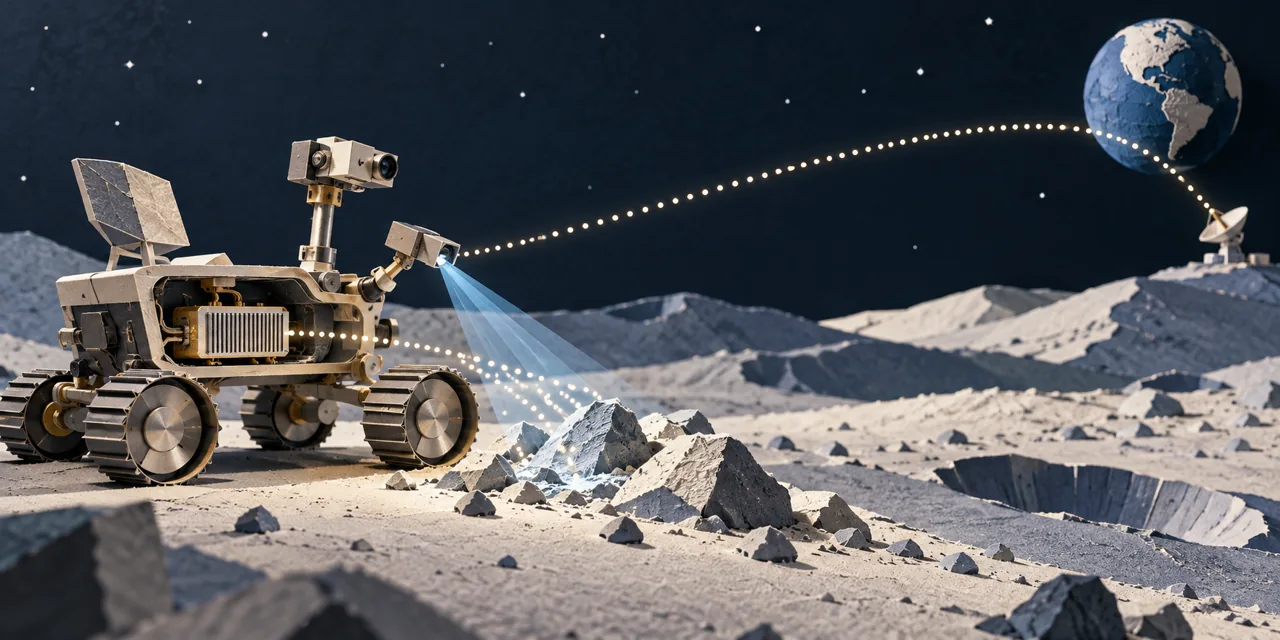
Lander testing answers a different question
In an October 13 update, revised October 14, NASA said Griffin-1 had completed environmental testing at JPL and returned for final assembly. The agency expected launch later in 2026, with FLIP among the payloads.
That is evidence of lander progress. It does not establish that HPE’s payload has completed qualification, that launch has occurred, or that an AI experiment has run on the lunar surface.
For readers tracking the project, those milestones deserve separate treatment. Assembly, launch, landing, computer operation, and useful experiment results would each answer a different question. Reporting them separately would make both progress and setbacks easier to interpret.
What would make onboard AI useful?
Our assessment is that the central question should be practical: does processing data near its collection produce useful mission insights? A demonstration would be more persuasive if it connected a completed task to a clearly stated purpose, rather than presenting execution alone as the outcome.
The same workload-first approach informs our related coverage of what NVIDIA’s DGX Spark can run locally. Here, the evaluation should follow the lunar experiment’s objectives. A product label or broad AI category is only a starting point for deciding what evidence to request.
The results worth watching
A strong follow-up report would distinguish work completed onboard from Earth-based support. It would identify the workload, explain the operating conditions, describe unsuccessful attempts, and show whether repeated runs produced consistent outcomes.
Benchmark scores would be useful alongside task-specific results, not as a substitute for them. Readers should also look for enough detail to understand the relationship between resources consumed and useful output. Until that evidence arrives, the appropriate conclusion is bounded: the announced experiments offer specific questions to investigate, while the answers remain ahead.
Sources
- HPE announcement — October 20, 2026.
- NASA rover progress update — October 20; updated October 21, 2026.
- NASA lander testing update — October 13; updated October 14, 2026.
- Astrolab — undated; checked October 22, 2026.