Dek: The Zhenwu V900 has announced memory, bandwidth, and low-precision support, but its performance claim and enormous cluster ceiling still need independent evidence and a commercial deployment.
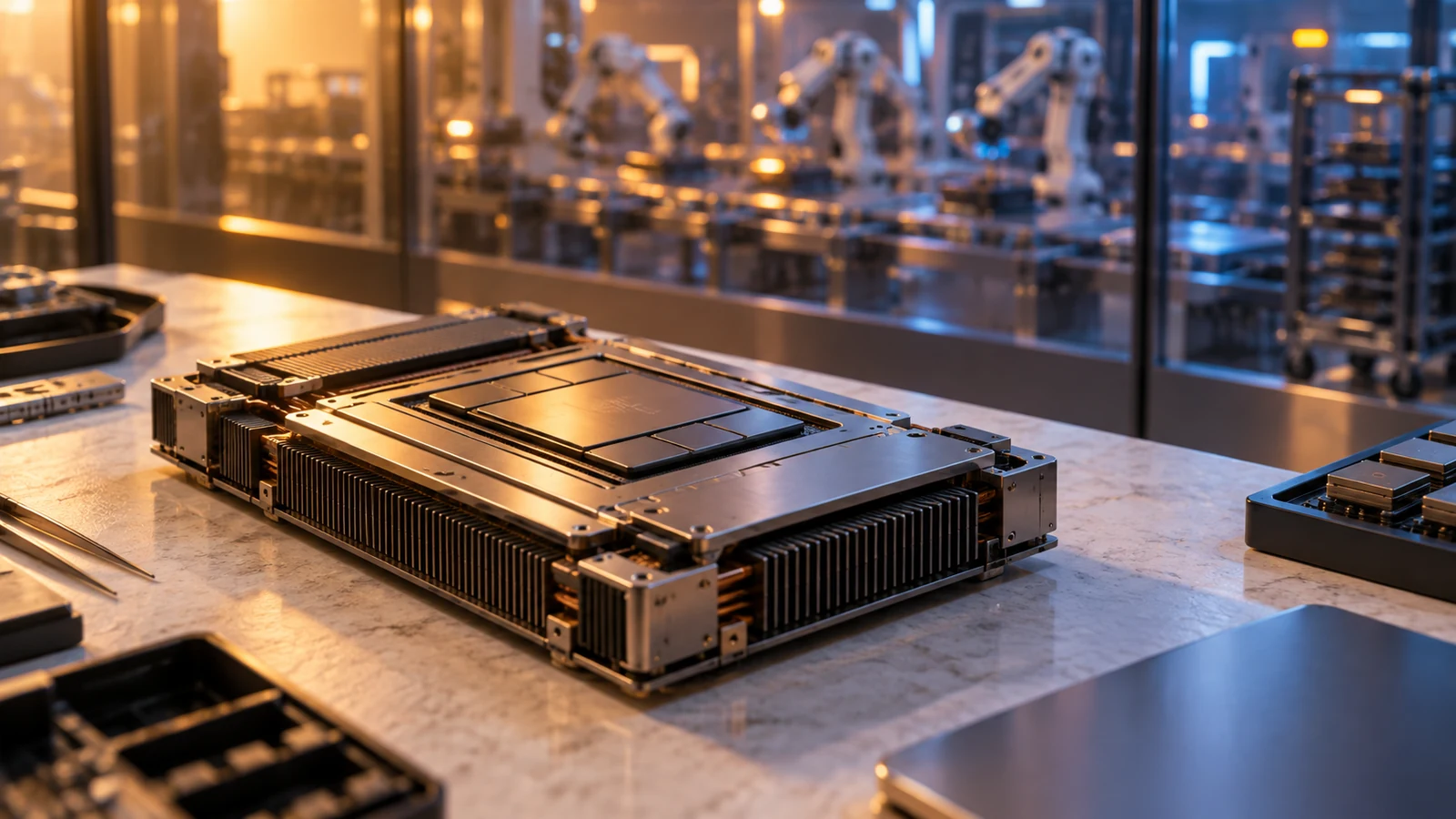
Alibaba has put numbers behind its next AI chip, but not yet the evidence a buyer would need for a purchasing decision. In its September 22 Apsara Conference release, Alibaba Cloud introduced the Zhenwu V900, a training and inference processor designed by its T-Head unit. The company lists 216 GB of GPU memory, 1,200 GB/s of inter-chip bandwidth, and support for FP8 and FP4. It also says the chip delivers three times the performance of the earlier M890.
The commercial clock is the central qualifier. Alibaba targets mass production and commercial release in the first quarter of 2027. That is a future company schedule, not evidence that V900 is already shipping to customers. For US infrastructure teams, the September announcement supplies a product to watch and a set of questions to prepare. It does not yet establish a purchasable alternative to an accelerator already available in their market.
What the V900 specifications establish
The announced memory and bandwidth figures give prospective evaluators a starting point for understanding the chip’s intended role. FP8 and FP4 support signals that Alibaba is designing for lower-precision AI computation. But the published figures alone cannot show application throughput, latency, energy efficiency, or system economics. Those outcomes depend on workloads and a complete deployment configuration that the announcement does not document.
The strongest performance language in the release is explicitly Alibaba’s. It calls V900 the most powerful AI chip in China and says it performs at 3× the M890. The release does not disclose the workload, numerical precision, system setup, or comparison baseline behind the multiplier. It includes no independently reproducible benchmark. Readers therefore have a vendor comparison with its own predecessor, not a measured comparison against Nvidia products or other accelerators.
| Alibaba’s V900 statement | What is established | What remains open |
|---|---|---|
| 216 GB GPU memory; 1,200 GB/s inter-chip bandwidth; FP8 and FP4 support | Published product specifications | Workload results, power draw, and system-level cost |
| Three times M890 performance | Alibaba’s performance claim | Test conditions and independent replication |
| Q1 2027 mass production and commercial release | Company schedule | Actual volume, delivery, and customer access |
| Supernode supports up to 500,000 cards | Stated scale ceiling | Whether a system at that size has been tested or deployed |

The cluster figure is a design claim, not a deployment count
Alibaba says an upgraded supernode brings together V900, ICN Switch, Panmai SmartNIC, and the Zhenyue SSD controller. It says the design can support clusters of up to 500,000 cards. The figure describes an announced upper bound. The release does not say a 500,000-card V900 cluster is operating, nor does it establish whether that number reflects a tested limit, an architectural plan, or a commercial target.
That distinction matters because a large accelerator fleet is more than a count of chips. An operator would need to know the network topology, power draw, cooling requirements, storage behavior, software support, and operational reliability before assessing whether the stated scale is useful for its workloads. The September material leaves those details open. A capacity ceiling should not be read as proof that customers can build, run, or buy a system of that size today.
An established chip family does not mean V900 has shipped
There is real context behind the announcement. Alibaba says the broader Zhenwu family serves more than 650 customers, and it identifies companion network and storage components for the V900 supernode. Along with a dated commercial-release target, that points to a coordinated hardware roadmap rather than an isolated chip name. It does not mean 650 customers have received V900, or that V900 production yield, shipment volume, or customer deployments are known.
Manufacturing is another unanswered part of the story. The Associated Press reported analysts’ view that progress depends on foundry and manufacturing capability as well as chip design. That is a general constraint on turning an announced processor into available systems; it is not evidence of a specific V900 defect. Alibaba has not provided a process node, fabrication capacity, yield, memory-sourcing plan, or production-volume estimate in the reviewed release.
The company’s ambition extends beyond the chip. In his Apsara keynote, Alibaba Group CEO Eddie Wu said Alibaba Cloud targets more than 20 GW of global data-center capacity by 2032 and that supply-chain shortages constrain scaling now. The 20 GW figure is a long-term company target, not secured power or currently operating capacity. It helps explain why Alibaba is presenting chips, networking, and data-center expansion as connected plans, while leaving execution to be demonstrated.
What US buyers should wait to see
The announcement did not publish V900 pricing, a US sales channel, a US cloud region, or terms for buyers in other English-speaking markets. It also leaves software compatibility, power and cooling needs, system price, and independent workload results unspecified. No firsthand V900 deployment, benchmark, or customer report appeared in the public material reviewed as of September 25, 2026, 20:13 KST. September 22 community discussions repeated the news and speculated about future hardware; they are not independent tests or a representative survey of users.
For procurement teams, the next meaningful evidence would be actual commercial availability, supported software, price and delivery terms, and matched tests on relevant workloads. Those are also prerequisites for a credible comparison with Nvidia or any other supplier. A vendor’s predecessor multiplier cannot establish competitive parity or superiority on its own.
If Alibaba meets its schedule and ships V900 at scale, its combined accelerator, network, and storage approach could matter to cloud procurement and to demand for power, cooling, and related components. That remains a conditional outcome. The V900 announcement establishes a specification sheet, an ambitious system design, and a Q1 2027 target. Whether buyers can obtain a competitive, usable system is the question the coming release must answer.