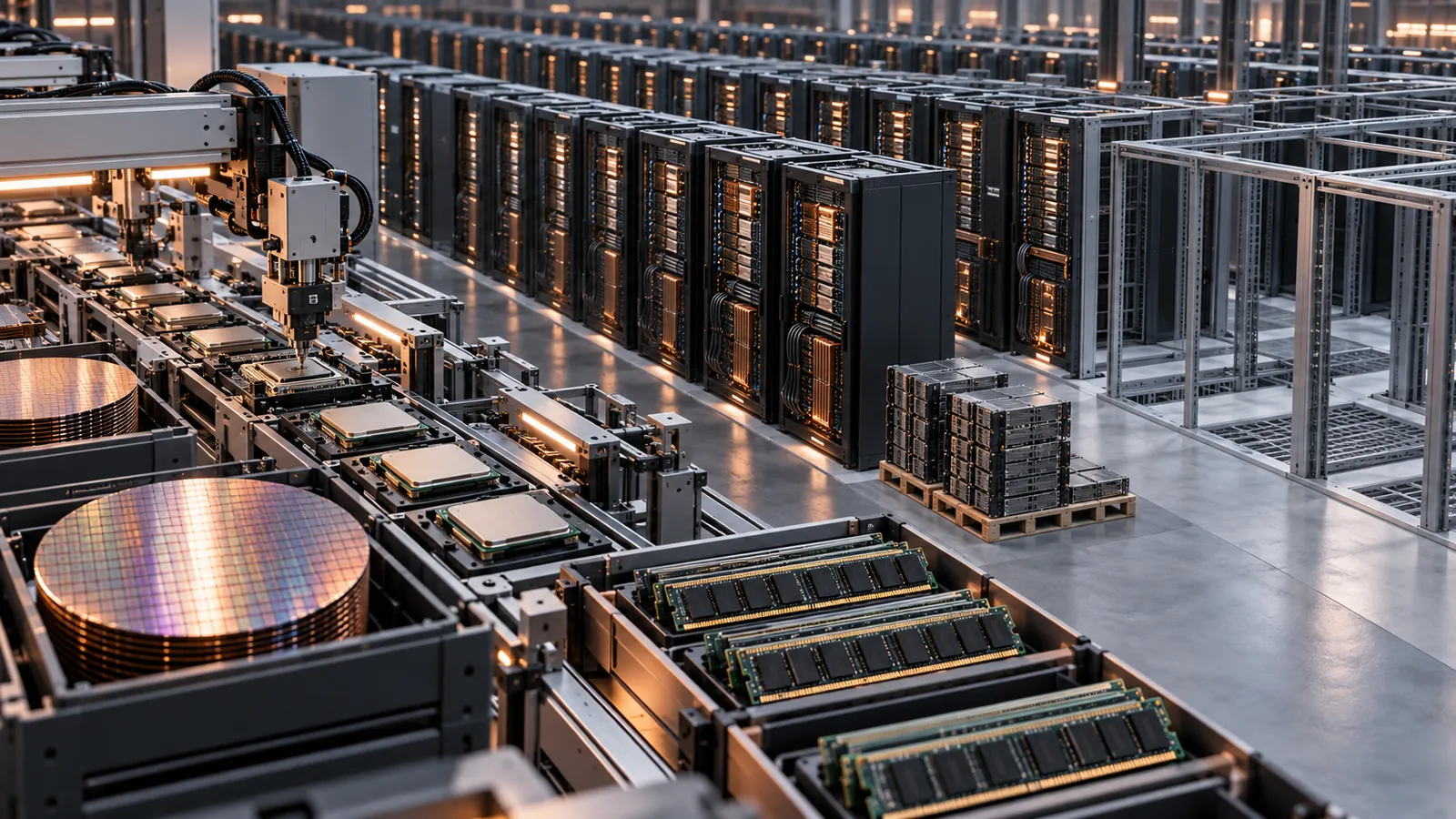
Six days after Akamai announced an approximately $11.6 billion, seven-year cloud commitment with Anthropic, the most concrete hardware story is about procurement and delivery. Akamai says Anthropic needs capacity for growing CPU workloads. It also plans roughly $5.5 billion in related capital expenditure and has authorized a major memory purchase. What it has not provided is a bill of materials: no CPU maker, chip model, server count, memory configuration, or site list.
That distinction matters for infrastructure buyers. A contract of this size signals demand for computing capacity beyond the accelerators that dominate AI headlines, but it cannot yet identify a winning processor supplier or establish what Anthropic will run on the machines. The public record gives a schedule for building capacity, not a benchmark for using it.
The capital plan is more specific than the server plan
Akamai’s September 24 investor presentation allocates the estimated $5.5 billion of capital spending across three periods: $1.7 billion in the fourth quarter of 2026, $3.1 billion in 2027, and $0.7 billion in 2028. Akamai said its 2026 revenue guidance was unchanged while it increased expected 2026 capital spending by about $1.7 billion to secure and pre-purchase supply-chain components, including memory.
The September 24 SEC filing supplies an unusually tangible detail: Akamai authorized Jabil to purchase approximately $1.7 billion of memory components. Akamai pays the supplier invoices when Jabil receives the components. Jabil then holds them on consignment and repurchases them at cost as they are used. That is a procurement arrangement, not evidence that all memory has been installed or that its final server configuration is known publicly.
The memory authorization should also not be added to the $5.5 billion capex estimate as though it were a separate $1.7 billion buildout. Both numbers describe aspects of Akamai’s stated investment plan; the disclosures do not support double counting them.
Memory is a particularly revealing input because securing components precedes the arrival of a functioning cloud service. But the dollar figure cannot be converted into a number of servers: purchase prices, component types, capacity per system, and allocation across deployment phases are absent. Even a plausible industry configuration would be a guess about this contract. For a buyer, the useful signal is that Akamai has moved beyond an abstract capacity promise to a defined purchase mechanism, while the equipment needed to turn that supply into usable instances remains undisclosed.
| Disclosure | What it establishes | What it does not establish |
|---|---|---|
| CPU workload growth | The capacity Akamai says Anthropic wants | CPU brand, model, count, or exact workload |
| About $1.7B in memory purchases authorized through Jabil | A concrete supply commitment and payment mechanism | Installed capacity, memory type, or system design |
| About $5.5B estimated capex | Scale and staged spending through 2028 | Final cost, performance, or utilization |
| 95–105 MW | Power for prior large cloud commitments plus Anthropic | Anthropic’s share of the power |

Delivery comes well after the announcement
The same presentation forecasts service initiation in late Q2 2027, with revenue rising during the second half of that year. Akamai estimates $150 million to $300 million of revenue from the commitment in 2027, followed by a $1.7 billion annual revenue run rate at the end of 2028. These are company estimates as of September 24, 2026, subject to change. They describe a staged ramp, rather than $11.6 billion arriving when the deal was announced.
Delivery is a commercial constraint as well as a construction task. The SEC filing says Anthropic’s payment commitment is subject to Akamai meeting delivery and service-availability requirements and to termination rights. Each of the two new Project Plans has an initial seven-year term beginning on its own service start date. A material outage can give Anthropic a conditional termination right. Procurement, installation, power, network readiness, and dependable service all sit between a signed plan and sustained revenue.
That sequence creates the central tension: Akamai is committing capital early to secure components, while the service and revenue ramp lie ahead. The spending schedule makes the infrastructure bet measurable, but it also exposes execution risk. A buyer assessing this announcement should track actual service starts and availability against the forecast, rather than treating a headline contract value as delivered capacity.
The phased dates also limit what can be learned from the first months of service. A late-Q2 start would establish that some capacity is available; it would not prove the full seven-year footprint is installed. Conversely, a slow 2027 revenue contribution is already part of Akamai’s own forecast, so the early ramp should be judged against the company’s published schedule rather than against the contract total divided evenly by seven.
The power number covers more than Anthropic
Akamai projects approximately 95–105 megawatts to deliver its prior large Cloud Infrastructure Services commitments and the Anthropic commitment. It also presents an estimate of roughly $22 million in annual revenue per megawatt. The 95–105 MW range is therefore a combined portfolio requirement. Dividing or assigning that total to Anthropic alone would imply a deal-specific measurement Akamai has not published.
For capacity planning, the power disclosure is still useful: it shows that electricity and facilities are part of Akamai’s broader delivery challenge. It cannot reveal which campuses, regions, cooling designs, or Anthropic capacity blocks account for that load. Regional availability and the timing of each deployment remain open questions.
CPU demand does not name a chip winner
The press release uses the term “CPU workloads,” but Akamai has not disclosed a processor manufacturer or system specification. It has not disclosed whether accelerators are present or absent in the environments covered by the new plans. Nor has it said that CPUs replace GPUs used for frontier-model training. Those would be different technical claims requiring different evidence.
AMD has described general CPU roles in agent systems, including retrieval, tool calls, and code execution. That vendor account helps explain why AI services may need CPU capacity, but it is not a disclosure of Anthropic’s workloads or Akamai’s purchases. TechCrunch likewise noted that Akamai did not specify Anthropic’s exact uses. Neither source supports naming AMD, or any other vendor, as the supplier here.
The SEC filing also describes a separate September 23 agreement with Lenovo for hardware products, software, and related services under a seven-year statement of work. It does not identify the products or connect that statement of work to Anthropic. Lenovo cannot be treated as the server or CPU supplier for this commitment on that evidence.
The questions for buyers are concrete: What CPU platforms and memory capacities will be deployed? How many systems and regions will enter service, and when? What performance and availability will they deliver under real workloads? Akamai has not answered these publicly. A broad memory shortage, a specific semiconductor market-share shift, or a cost-per-token advantage also cannot be inferred from the filing.
As of September 30, no newer Anthropic-specific Akamai announcement had emerged in the reviewed company release and investor-event records. The full master services agreement is expected as an exhibit to the Form 10-Q for the quarter ending September 30, according to the 8-K. Until more terms and deployment evidence appear, the strongest conclusion is narrower than the deal’s dollar figure: Akamai has disclosed a substantial, staged CPU cloud buildout with real memory procurement and delivery obligations, while the hardware mix and Anthropic’s exact capacity remain unknown.